
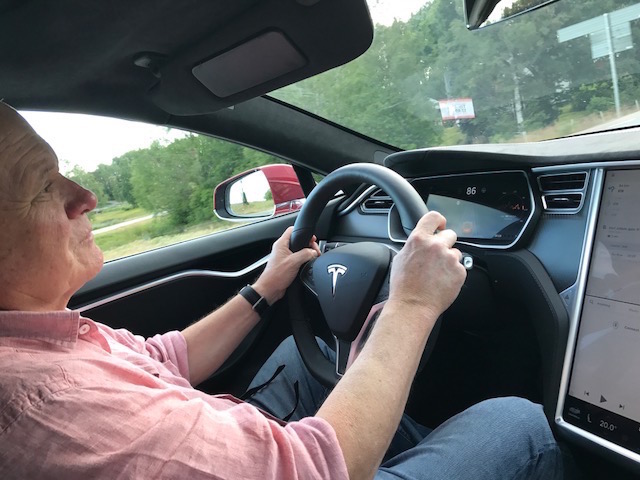
The picture above of me at the wheel of an electric Tesla Model S 100D sedan was taken the other day between Stockholm and Oslo, cities around 530km apart.
I’m in Scandanavia to talk to electric vehicle groups, specifically the secretary-general of the Norwegian Electric Vehicle Association (NEVA).
Her name is Christina Bu – and she spent a year at high school in New Zealand in the late 1990s as an exchange student.
These days she’s very much the teacher in a global classroom – the world’s carmakers, transport companies, politicians, environmental policymakers … they all want to talk to her.
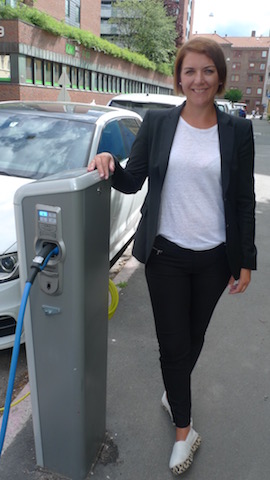
During our meeting an email from a transport company executive in New Zealand landed on her smartphone. He was asking for an appointment. But more on Christina and her role in a later story.
Norway, a country of 5.2 million people, whose wealth is based on fossil fuels, has become the world leader in electric cars. About 35 per cent of new cars are EVs, and the country has a target of zero emissions for all new cars by 2025.
There are 15 different all-electric cars available in Norway, more than most other markets. Diesel’s market share in falling fast. It sits at 13 per cent as local governments explore restrictions on the fuel.
Norway’s hydro-electric stations supply about 97 per cent of the country’s energy needs. Gas-fired stations supply the remaining three per cent, but they are soon to close.
In New Zealand, upwards of 85 per cent of the country’s energy comes from hydro-electric stations. There are around 117,000 cars with plugs in Norway, about 4 per cent of the total fleet. Six years ago there were 5000 such cars.
By 2020, Norway expects to have 170,000. Since 2011, sales of EVs – battery-electric (BEV) and plug-in petrol-electric hybrids (PHEV) – have doubled each year.
New Zealand has around 2000 cars with some form of electrics helping to move them along. By 2020, New Zealand might have 4000 such cars. Transport Minister Simon Bridges’ plan for 70,000-odd EVs by 2022 has a long way to go.
Norway has around 800 quick charge stations – New Zealand is aiming for 100 by the end of this year. Almost 5000 plug-in EVs were sold in Norway the first month of 2017, around 37 per cent of overall new vehicle sales. Among the number were 367 Teslas.
So far this year, fully electric cars represent about 18 per cent of all new sales, while plug-in hybrids have around 17 per cent.
NEVA expects 30 per cent of new cars this year to be fully electric, and 70 per cent by the end of the decade. It says about 72 per cent of buyers are choosing an EV for economic reasons and 26 per cent for environmental ones.
The Norwegian Government has made it happen, with attractive incentives. For instance, parking for EVs is free. So are tolls, fees on government-run ferries, charging stations …
Parking a petrol or diesel car in the basement of my hotel in Oslo would have cost around NZ$90 a night. The Tesla was free. Same at the hotel in Stockholm.
But the most pressing problem policymakers are facing as EVs head towards mass market transport is how to rein in the subsidies that underpinned the boom, so that electric cars can compete with petrol vehicles on a level playing field.
Norway taxes petrol and diesel cars more heavily the most EU countries. For instance, an SUV with a 4.0-litre V8 petrol engine carries a purchase tax of 230,000 Norwegian Krona (NKr230,000), or around NZ$40,000. Add 25 per cent Value Added Tax (VAT) and the total cost of the SUV works out at about NKr777,000 (NZ$130,000).
Tesla Models S and X cost about the same as the SUV but are free of purchase and VAT tax. A proposal to raise the road tax for electric cars while cutting it for petrol cars caused a crisis in the minority centre-right government last year. A general election is in a couple of months.
Anyway, the all-wheel-drive Tesla I was loaned showed a fully charged, battery-electric range of around 470km when I left Stockholm. It showed 92km when I pulled into a Tesla quickcharge station in Karlstad, about 220km short of Oslo.
About an hour later, after recharging the car, eating a hamburger at a joint called Max, the battery capacity meter showed I had 476km in reserve.
I must confess to some range anxiety. I’d deliberately gone into this journey cold-turkey, not having driven more than 30-odd kays in a Tesla S.
But the anxiety was just rookie EV nerves. They settled down once I figured out how to find the Tesla quickcharge stations and plot the distance between them. The tablet-like touchscreen has all the answers.
I first stopped near Orebro, around 200km west of Stockholm. The capacity meter showed enough battery power for another 297km. The list of quickcharge stations offered options: I could go back 37km to one station, or keep going to Karlstad.
Dialing in a Tesla quick charge, or supercharge, station on the touchscreen overrides any address you might have set on the satellite-navigation – the system is a homing pigeon.
Next stop is Estonia, then Russia, Finland – where Tesla has just set up shop – Poland, Germany, Denmark, and France. Each country has a history of revolution. The EV uptake is the latest uprising.