
• Skip to main content
  • Skip to secondary menu
  • Skip to primary sidebar
  • Skip to footer

AutoNews.NZ

  • Home
  • News
  • Reviews
    • Medium-sized cars
    • Small cars
    • Large cars
    • 4x4s
    • People-movers
    • SUV-large
    • SUV-luxury
    • SUV-medium
    • SUV-compact
    • Sports cars
    • Luxury cars
    • Hybrid cars
    • Ute
  • Cars & Watches
  • Bike World
  • Tech
  • About Us
  • Videos
    • Spy videos
Home » Citroen’s pillowy suspension system gone but not forgotten

Citroen’s pillowy suspension system gone but not forgotten

July 11, 2016 by Alastair Sloane

It’s the end of the line in New Zealand for the mid-sized Citroen C5 range – and with it goes one of the motoring world’s best innovations, the hydro-pneumatic suspension system.

The slow-selling C5 and Peugeot 508 sedan and wagon have been discontinued and will be replaced next year by altogether new models. “We’ve run out of C5 – same with 508,” said Peugeot-Citroen NZ divisional manager Simon Rose.

“We took the view that the sedan segment was declining, that (Peugeot-Citroen) SUVs were coming, so we said let’s get out (of sedans).

“We are in year of rationalisation for both brands. We are simplifying the business – we can’t have too many models. Same with Australia – they’re doing the same thing.”

It’s likely that the C5 will be the last mid-size passenger car carrying the Citroen badge. A replacement would likely come under the DS label, Citroen’s new premium brand.

Linda Jackson, CEO of Citroen

Indeed, Citroen CEO Linda Jackson has said there was a “question mark” over the future of C5 outside of the Chinese market, where mid-size and large sedans sell well. (Jackson has been named by the Society of Motor Manufacturers and Traders as the “most influential British woman in the car industry.”)

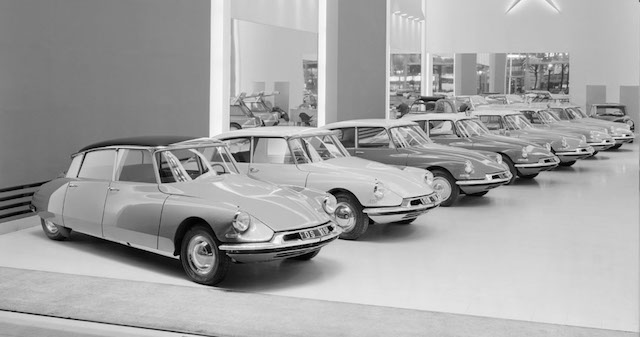
The seven-year-old C5 is the last car to use the in-house hydro-pneumatic suspension, first seen in 1954 on the rear axle of the Traction Avant but on all four corners of the famous DS 19 model in 1955. It replaced traditional leaf springs and shock absorbers.

Variations of the system have since been used in flagship Citroen models. The C5’s is called Hydractive III. Peugeot Citroen CEO Carlos Tavares scrapped it last year as part of cost-cutting measures, and Jackson herself said it was “old technology.” She said future Citroens would provide comparably smooth rides by using new technology.

“Comfort suspension is 100 per cent part of our DNA,” she said. Newer technology such as computer-assisted semi-active systems have allowed carmakers to provide the advantages of hydro-pneumatic but at a lower cost.

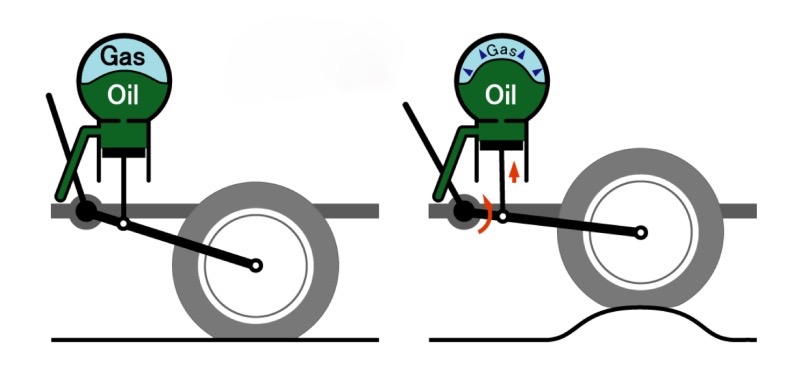
Six decades ago the ground-breaking system was viewed as a mechanical marvel, wowing all with its adjustable ride height and self-levelling ride quality. It is simple in operation, based on the fact that a gas can be compressed but a fluid cannot. But nevertheless it earned a reputation for complexity.

Citroen replaced leaf springs and shock absorbers – used by pretty much every carmaker back then – with pneumatic spheres at each wheel. One half of the sphere was filled with trapped nitrogen gas; the other with hydraulic fluid pressurised by an engine-driven pump.

The gas acts as the spring; the fluid as the shock absorber. The movement of other suspension components – control arms and swing arms – pushes the fluid around to compress gas in the spheres to smooth out bumps in the road and provide a pillowy ride.

A bonus was self-levelling suspension, so efficient that that the DS and subsequent models could be driven on three wheels without the ride height being affected.

The efficiency of self-levelling was aptly demonstrated by the BBC’s regular coverage of horse racing in Europe. For years its camera teams used Citroen Safaris to keep cameras on an even keel while filming the field from inside the rails.
ep2ymas0bxorjcfe7txq


Filed Under: Highlights, Industry news, Latest news Tagged With: Citroen

Primary Sidebar

  • Facebook
  • RSS
  • Twitter
  • YouTube

Search

The Good Oil

French carmaker Renault has won the 2025 European Car of the Year award with the all-electric R5 supermini (pictured). It’s the brand’s second win in a row, following the new Scenic’s gong in 2024. The R5 led the vote count from start to finish from the 60 jurors in 23 countries. It received 353 points, beating the Kia EV3 (291 points) and the Citroen C3/e in third place with 215 points. It’s Renault’s eighth win in the 62-year history of the Coty award. The R5 goes on sale in the UK this month. There are two main drivetrains: a 90kW motor/40kWh battery model with a 300km range, and a 112kW/52kWh example with a 400km range. The R5 starts in price at £22.995, or $NZ50,000.

EU carmakers seek trade deal with Trump

BMW and Mercedes-Benz are among carmakers urging the European Union to get a favourable trade deal with US President Donald Trump. The European Automobile Manufacturers’ Association (ACEA) wants to keep open trade with both the US and China. It fears Trump, who promises heavy tariffs on Chinese imports to the US, will look unfavourably on countries that continue to trade freely with Beijing. Ola Kallenius, president of the group and chairman of the management board of MB, said in a letter to EU leaders:  “Overall, it is essential to recognise that trade with China and the US is most vital for the prosperity of the European economy.The EU should seek a grand bargain with the US and attempt to avoid a potential trade conflict.”

Diesel fuels EV concept for US military

A  go-anywhere EV concept for the US military uses an onboard 12kW diesel generator to top up the batteries on the move.  The all-wheel-drive has 800-volt technology and a 200kWh battery pack to power three electric motors, two in the rear and one up front. Claimed output is 745kW/15,590Nm, or 1000hp and 11,500 ft-lb of torque.  The four-seater was developed by the defence division of General Motors and is based on the platform of the Hummer SUV. It rides on Fox performance shock absorbers and 37-inch tyres and comes with “exceptional” approach and departure angles for off-road mobility. Maximum range using the generator to keep things ticking over is said to be around 500km.

We are the World

The outside temperature in Midland, Texas, was 40.5C when staff at the local office of the US National Weather Service set out to show the cabin of a closed car can literally get baking hot in summer. They mixed up a batch of chocolate chip cookies and laid them on the car’s dashboard – the surface of which showed a temperature of 87.7C. A little over four hours later the cookies were ready to eat. “Even though ours weren’t golden brown, we can confirm that they are done and delicious,” the staff wrote on Facebook.

Footer

Electric G-Wagen takes you for spin

https://youtu.be/NwHbJ7HN1sU

Recent

  • Bond 007 electric car is from China with love
  • Power cut: sales of EVs down 65%
  • PM Luxon taken for ride in ‘Chinese spy car’
  • China’s ‘creeping takeover’ of Western automotive rivals 
  • Domestic price war among Chinese carmakers risks exports

Tags

Aston martin audi bentley BMW Car reviews Citroen Electric cars Electric vehicles Ferrari Fiat Chrysler Ford Ford Mustang Holden honda hyundai jaguar jeep kia land rover latest news Lexus Lotus Maserati mazda Mclaren mercedes Mercedes-Benz mini Mitsubishi Nissan NZ car sales peugeot porsche range rover skoda spy Subaru suzuki Tesla tips and advice Toyota videos Volkswagen volvo VW

Copyright © 2026 · WordPress Hosting by WPhost