

The Quattro A1 Group B rally car that brought Audi its first manufacturer’s World Rally Championship title has been sold in Britain for just short of NZ$500,000, coincidentally 35 years after the first Quattro prototype was unveiled at the 1980 Geneva motor show.
Finnish ace Hannu Mikkola used the all-wheel-drive car in the 1982 Monte Carlo Rally, finishing second behind the Opel driven by Germany’s Walter Rohl. Mikkola finished third in the drivers’ championship that year behind Rohl and second-placed Michele Mouton who, with co-driver Fabrizia Pons, created female firsts by winning the rallies of Portugal, Greece and Brazil in another Quattro.
In the 12 events of 1982, the Quattro had seven wins, four seconds and one third. In 1983, Mikkola would win the drivers’ title for Audi. Lancia, thanks largely to the efforts of Rohl and Sweden’s Markku Alen, pipped Audi for the manufacturer’s gong. In 1984, Audi won both the drivers’ and manufacturers’ titles. (The picture at top shows Mikkola’s Audi during the 1984 rally of Portugal).

In four short years Audi had turned a Geneva show prototype into a giant-killing rally car that soon became a game-changer in the world of high-performance road cars.
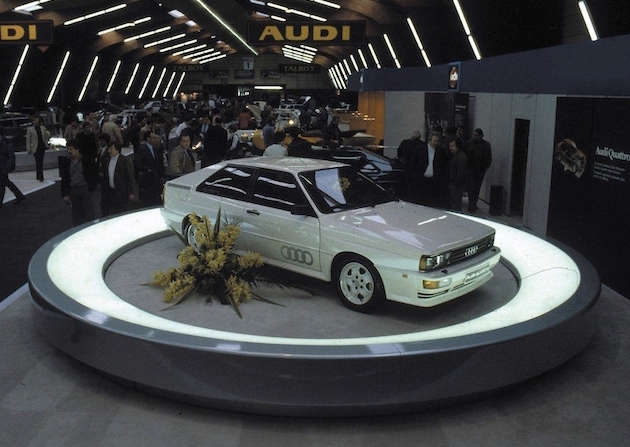
Audi unveiled Quattro at the 1980 Geneva motor show. It was white, weighed 1300kg and based on the existing front-drive coupe’s bodyshell. But it used a different floorpan to accommodate four-wheel-drive and independent rear suspension. The engine was a development of Audi’s five-cylinder, 2.1-litre unit, in this case making 147kW and 285Nm.
Audi had actually begun working on an all-wheel-drive prototype nine years earlier, under the direction of engineer Ferdinand Piech, now the chairman of the Volkswagen Group. But it wasn’t until 1976-77 that the project took shape.
Piech and his engineers had been using a modified two-door VW Passat as the prototype, replacing the Passat’s straight-six engine with the five-cylinder unit he had built, using an earlier Mercedes-Benz diesel as a template.

The first prototypes were front-wheel drives as the team sought to find out exactly how much performance a front-drive car could handle. It consumed engineers during test drives in the snow in Sweden in 1976-77.
The camouflaged Audi prototypes with their 125kW five-cylinder engines put in a worthy performance. But they were left standing when pitted against VW’s 55kW Iltis military off-road vehicle.
The solution was obvious: a sporty Audi car with permanent all-wheel drive and plenty of engine power. The team knew that a car that distributes engine power to all four wheels was capable of withstanding higher lateral forces than one with rear- or front-wheel drive. Therefore, its traction and cornering power was superior.
The project got off the ground in the early part of 1977 as “Development Order 262”. It was masterminded by Piech, project manager Walter Treser and chassis chief Jorg Bensinger and codenamed “A1”.

The prototype was a modified first-generation Audi 80 coupe with a slightly elongated wheelbase and five-cylinder turbocharged engine. The rear suspension was a second McPherson front suspension layout, rotated through 180 degrees.
In January 1978, trials began in deep snow in Austria. The prototype quickly showed how effective it was. But there was a hitch. The wife of VW development director Ernst Fiala had been driving another A1 prototype in city traffic in Vienna and complained that the car felt “tense” on tight bends: “The car ‘hops’,” she said.
On bends, the front wheels took a slightly larger arc than the rear wheels, because the A1’s axles were rigidly connected. The wheels needed to rotate faster.
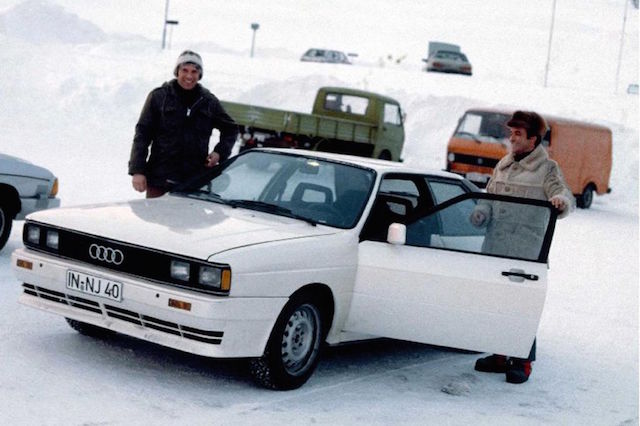
Audi’s developers focused on two objectives: the all-wheel drive was to be permanent, and it had to function without a separate transfer case and second propshaft at the front. What followed was the “eureka” moment, perhaps the best illustration of Audi’s advertising catchphrase ‘Vorsprung durch Technik.’
Audi’s transmission design chief Franz Tengler hit upon an idea as simple as it was practical: a 26.3cm long, hollow-drilled secondary shaft in the transmission, through which the power flowed in two directions.
From its rear end, the shaft drove the cage of the manually lockable centre differential. The differential transmitted 50 per cent of the power via the propshaft to the rear axle, which had its own differential lock.
The other half of the drive torque was transferred to the front axle’s differential along an output shaft rotating inside the hollow secondary shaft. The hollow shaft permitted all-wheel drive that was virtually tension-free, light, compact and efficient.
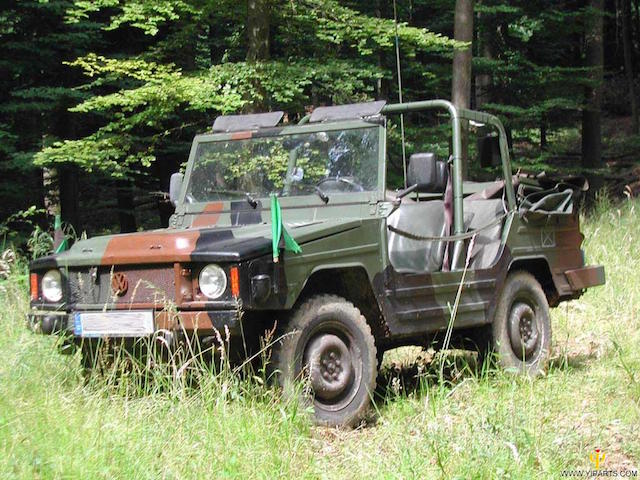
The vital breakthrough was that the Quattro principle was no longer merely suitable for slow all-terrain vehicles and trucks but also for fast passenger cars – and furthermore for volume-produced models.
All that remained was the name. One suggestion was “Carat”, an acronym of the German for “Coupe All-Wheel Drive Turbo.” Project manager Treser came up with “Quattro”.
Said the then design chief Hartmut Warku of the name: “We wanted to symbolise a car that stands firmly on the ground. It was meant to put the emphasis on what it was capable of doing, not on what it looked like.”
Production began at the end of 1980. Audi had initially planned to build only 400 units to enable the competition car to obtain homologation for the World Rally Championship.
But the revolutionary drive concept and its dynamic performance captivated the public from the very first day, and Audi had difficulty keeping up with demand.
Four years later the Sport Quattro appeared. It had a shorter overall length and wheelbase and was the homologation model of the new rally car. Its lighter materials reduced overall weight, and its new four-valve turbocharged engine with an aluminum engine block delivered 225kW.
Over time Audi improved the car inside and out. The most important technical change came in 1987. The engine had been bumped up to 2.2 litres but the Quattro now featured the Torsen differential; the worm gear replaced the manual differential lock. The name Torsen was a contraction of the two words torque and sensing.
The transmission distributed power continuously but instantly diverted up to 75 per cent of torque to whichever pair of wheels achieved better grip. Thanks to the Torsen differential, which only locks up under load, the anti-lock brake system remained permanently available.
When production ended in May 1991, Audi had built 11,452 Quattros, 224 of which were Sport versions. This year Audi is celebrating Quattro’s 35th birthday.